LEDの熱管理:ジャンクション温度と寿命

LEDの熱管理:ジャンクション温度と寿命
著者 BQUQ Engineering Team 査読 BQUQ Quality Engineering 2026年6月19日 更新 2026年9月11日 ビュー ISO 9001:2015 認証工場

LEDの熱管理:ジャンクション温度と寿命

Short answer: hold the LED junction below about 85–105 °C and most power LEDs deliver their rated L70 lifetime of 50,000–100,000 hours; run the junction 20–30 °C hotter and expected life can drop by half to two-thirds. Because LED light output and lifetime both degrade with temperature, junction temperature is the single number that links your thermal design to your warranty cost. A 50 W LED module at 50% efficiency dumps 25 W of heat into the heat sink, and that heat must move through a thermal budget of typically 0.5–2.5 K/W from junction to air.

LEDs are efficient compared with incandescent lamps, but they are not cold. A mid-power LED converts only 30–50% of input power to light, and the rest is heat generated in a chip a few square millimeters across. That makes the LED package one of the densest heat sources in electronics, and it is why junction temperature, not ambient temperature, is the number that decides how long the luminaire lives.

What Junction Temperature Actually Controls

The junction temperature Tj is the hottest point in the LED die. Three things respond to it. Light output falls with temperature, typically 3–10% luminous flux loss by the time the junction runs at 100 °C versus 25 °C. Color shifts: phosphor-converted white LEDs drift in CCT as the die heats. Lifetime collapses: lumen maintenance follows an Arrhenius-type acceleration, which is why industry lifetime figures are always quoted at a specific Tj. Most manufacturers publish L70 lifetime at a reference junction temperature such as 85 °C, and a common rule of thumb is that each 10 °C rise in Tj roughly halves the remaining life.

That last point deserves the emphasis. The difference between a well-sinked luminaire at Tj 75 °C and a marginal one at Tj 105 °C is not a subtle 30% effect. At the typical acceleration factor, the hot one can fail its L70 target in a fraction of the rated time, which is exactly how "100,000 hour" LED street lights end up dim in year three. Real lifetime claims come from LM-80 testing of the LED package and TM-21 extrapolation, and both are only valid at the junction temperature your heat sink actually delivers.

Building the Thermal Budget From Tj Down

Thermal design for an LED starts at the junction and works outward. The budget is:

Tj = Ta + P·(Rth j-c + Rth c-s + Rth s-a)

where P is the heat in watts, Ta ambient temperature, Rth j-c the package's junction-to-case resistance from the datasheet, Rth c-s the interface between LED package and heat sink, and Rth s-a the heat sink's case-to-ambient resistance. Worked example for a 30 W COB module running at 33% efficiency: 20 W of heat, Rth j-c of 0.5 K/W, a good thermal pad at 0.3 K/W, and you need the heat sink plus airflow to cover the rest.

ComponentTypical Rth (K/W)Notes
LED package j-c (1–10 W power LEDs)2–8Higher for small packages
LED package j-c (COB modules)0.3–1.5Larger die, direct mount
TIM / thermal pad0.1–1.0Depends on thickness and pressure
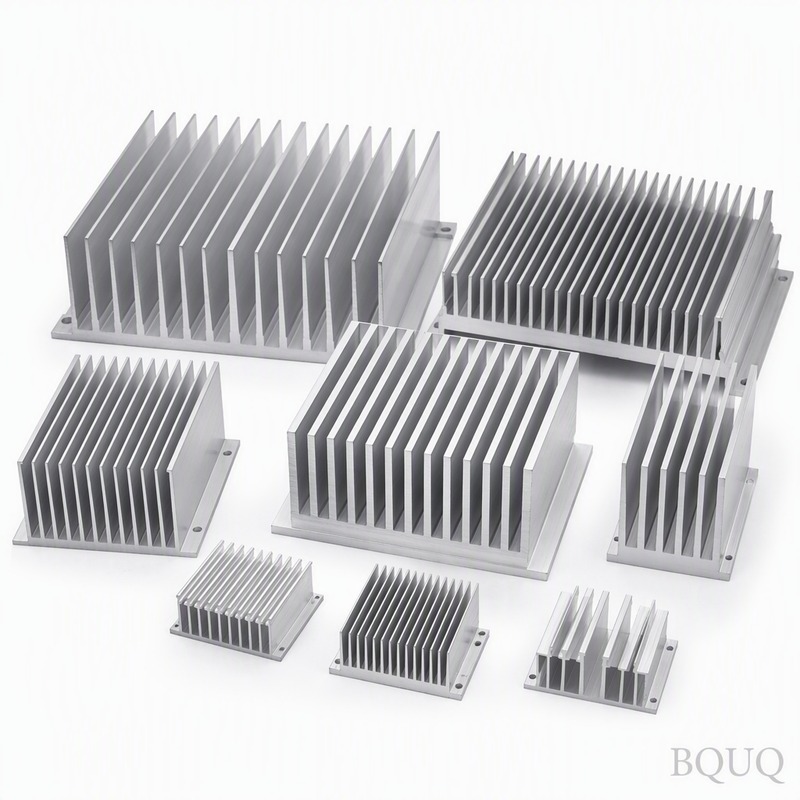
Extruded heat sink, natural convection1.0–3.0Size and fin field dependent
Extruded heat sink, forced air0.3–1.0Fan required, noise trade
Heat sink plus heat pipe spreader0.2–0.6For high-power area sources

Try the arithmetic at the extremes. A 20 W heat load, Rth j-c 0.5, pad 0.2, and a natural-convection sink at 1.5 K/W gives Tj = Ta + 20 × 2.2 = Ta + 44 °C. At 40 °C ambient, that is 84 °C at the junction, right at the comfort boundary. Bump the heat load to 30 W or the ambient to 55 °C for an enclosed street-light housing, and the same stack overshoots 100 °C. That is why LED heat sink selection is a calculation, not a size guess.

The Failure Modes Hot Junctions Cause

Junction temperature does not kill the die abruptly at a magic number, but several failure mechanisms accelerate with temperature. Phosphor degradation darkens white LEDs and shifts color. Solder fatigue at the die attach and at the board connection grows with thermal cycling amplitude, so a design that runs hot and cycles between day and night thermally stresses joints more than a steady warm one. Electrolytic capacitors in the LED driver age by roughly half per 10 °C rise. And in the worst case, a runaway failure: if the thermal path degrades, Tj climbs, efficiency drops, more input power becomes heat, and Tj climbs further.

Thermal runaway is the reason a heat sink for LED lighting is a safety component, not an accessory. For outdoor fixtures, anodized aluminum housings with sealed driver compartments are the norm; BQUQ machines and stamps these housings with machined LED mounting faces so the board-to-housing interface stays flat and thin, and we black-anodize them to improve radiative exchange. Small gains, but at the LED power densities above, every 2–3 °C saved at the case is real lifetime at the junction.

Sizing the Heat Sink From a Lifetime Target

The professional way to size an LED heat sink is backwards from the warranty. Decide the L70 lifetime you must deliver, read the LM-80/TM-21 data at that lifetime to find the maximum Tj, then solve the budget for the maximum Rth s-a the heat sink may have at your worst-case ambient and drive current. Typical outcomes:

ApplicationTypical heat loadTypical target TjResulting Rth budget
5–10 W downlight3–7 W≤ 85–95 °C4–10 K/W
30–50 W street light module20–35 W≤ 85–95 °C1.5–2.5 K/W
100–200 W high-bay60–140 W≤ 90–105 °C0.4–0.9 K/W (forced air)
COB track head, 40 W25–30 W≤ 85–95 °C1.2–2.0 K/W

These are indicative budgets, not quotes. Two real-world corrections push most designs harder than the simple math: the heat sink base spreads heat from a small board, and real fins are not 100% efficient, which is why you should run the numbers with the fin efficiency and thermal resistance methods covered elsewhere. Ambient inside an enclosed fixture is also 10–20 °C above room temperature, so design on internal ambient, not the air outside the housing.

Checking a Supplier's Thermal Numbers

A credible LED heat sink quotation states its conditions. Look for the heat load in watts at which the resistance is quoted, the ambient temperature, whether the number includes a TIM and which one, and the orientation of the fins. A figure measured at 25 °C ambient with an ideal pad will not survive a 55 °C internal fixture temperature, and the shortfall is not the supplier's fault, it is the specification's. Ask the same question every way: what worst case does this sink meet, not what best case was it measured at?

The second check is the spreading story. LED boards are small relative to housings, so ask what source footprint and base thickness the design assumes. A thin housing wall behind a COB module adds a spreading penalty that no fin count reveals; a machined pad, a thicker local boss, or an embedded copper slug fixes it. If the supplier cannot state the assumed source size, the thermal analysis has not been done, and the first field failure will teach the difference at your cost.

Lifetime claims deserve the same scrutiny. If the fixture is warranted for 50,000 hours, ask what junction temperature the design holds at the worst-case drive current and ambient, and compare it with the LM-80/TM-21 data of the actual LED. A design that clears the junction limit by 5 °C is fragile; one with 15–25 °C of margin survives dust loading, driver tolerance and a hot summer. The margin is where the metal is spent, and it is cheaper to spend it in the extrusion than in the warranty reserve.

At BQUQ the LED housings and heat sinks we machine start from the module drawing: a flat mounting pad, a fastener pattern for uniform pressure, wall thickness sized to spread the heat, and black anodizing to add radiation on passive fixtures. Holding the pad flat to ±0.005 mm and machining the boss and fins from the same billet keeps the thermal path short and the interface thin. Send the LED module datasheet, driver current and ambient to sc@bquq.com or WhatsApp +86 13713157787, and the 12-hour quote will state the conditions the design meets.

Frequently Asked Questions

Q: What is a safe junction temperature for power LEDs?

A: For most power LEDs, keeping Tj at or below 85–105 °C preserves rated L70 lifetime; many datasheets specify lifetime at Tj 85 °C. Above roughly 110–120 °C, lumen maintenance and phosphor life degrade quickly and thermal runaway risk rises.

Q: How do I measure LED junction temperature?

A: The standard method is electrical: forward voltage of the LED is calibrated against temperature at a low sense current, then measured at operating current to infer Tj. Alternatively, estimate with Tj = Ta + P × total Rth using datasheet values, or spot-check the case with a thermocouple and add the datasheet's j-c drop.

Q: Why does my LED heat sink feel only warm if the junction is hot?

A: Because the thermal budget is a ladder. If the case-to-air resistance is high, most of the temperature rise is inside the package and the sink stays cool while the junction cooks. A cool heat sink on a hot LED usually means the interface or the package path is the bottleneck, not too little sink.

Q: What is L70 lifetime and why is it tied to temperature?

A: L70 is the hours until the LED emits 70% of its initial lumens, extrapolated from LM-80 data via TM-21. Lumen degradation is thermally accelerated, so L70 is always quoted at a junction temperature; run the junction hotter and the same LED reaches 70% output far sooner.

Q: What thermal specifications should I send with an LED heat sink inquiry?

A: Send LED power and efficiency or heat load in watts, worst-case ambient, target Tj or L70 hours, board size and mounting pattern, and whether airflow is allowed. BQUQ uses that to machine a sink and quote within 12 working hours: sc@bquq.com or WhatsApp +86 13713157787.

Related Resources

  • LED Heat Sink Selection Guide — matching sink geometry to LED modules and drivers.
  • CNC-machined heat sinks — machined mounting faces, tapped holes and anodized housings for LED fixtures.
  • About BQUQ — an ISO9001-certified source factory in Dongguan running CNC, stamping, spring and heat sink lines under one roof.
  • Contact us — send your drawing for a quote within 12 working hours.

Authored by the BQUQ Engineering Team. BQUQ is an ISO9001-certified source factory in Dongguan, China, running CNC machining, metal stamping, custom springs, heat sink and collet lines under one roof. Send drawings to sc@bquq.com or WhatsApp +86 13713157787 for a quote within 12 working hours. www.bquq.com


お問い合わせ見積もり
見積もりを取得する
私たちはあなたのオンライン体験を改善するためにcookieを使用しています。このウェブサイトを閲覧し続けることで、あなたはcookieの使用に同意したことになります。

Cookies

当社のサービスにアクセスまたは使用する前に、当社の利用規約およびこのポリシーをお読みください。このポリシーまたは利用規約に同意できない場合は、当社のサービスにアクセスまたは使用しないでください。欧州経済領域外の管轄区域にお住まいの場合、当社のサービスを利用することにより、利用規約に同意し、このポリシーで説明されているプライバシーに関する慣行に同意したことになります。当社は、事前通知なしにいつでもこのポリシーを変更することがあり、すでに保有している個人情報、およびポリシーが変更された後に収集された新しい個人情報に変更が適用される場合があります。変更を行う場合は、このポリシーの上部にある日付を修正して通知します。このポリシーに基づくあなたの権利に影響を与える個人情報の収集、使用、開示方法に重大な変更があった場合は、事前に通知します。欧州経済地域、英国、スイス以外の管轄区域にお住まいの場合(以下、総称して「欧州諸国」といいます)、変更通知を受け取った後も引き続き当社のサービスにアクセスまたは利用することは、更新されたポリシーに同意したことを示すものとなります。さらに、当社のサービスの特定の部分における個人情報の取り扱いに関する開示または追加情報を実際立って提供する場合があります。このような通知は、本ポリシーを補完する場合があり、また、当社がお客様の個人情報をどのように処理するかについて追加の選択肢を提供する場合があります。
CookiesCookies are small text files stored on your device when you access most Websites on the internet or open certain emails. Among other things, Cookies allow a Website to recognize your device and remember if you've been to the Website before. Examples of information collected by Cookies include your browser type and the address of the Website from which you arrived at our Website as well as IP address and clickstream behavior (that is the pages you view and the links you click).We use the term cookie to refer to Cookies and technologies that perform a similar function to Cookies (e.g., tags, pixels, web beacons, etc.). Cookies can be read by the originating Website on each subsequent visit and by any other Website that recognizes the cookie. The Website uses Cookies in order to make the Website easier to use, to support a better user experience, including the provision of information and functionality to you, as well as to provide us with information about how the Website is used so that we can make sure it is as up to date, relevant, and error free as we can. Cookies on the Website We use Cookies to personalize your experience when you visit the Site, uniquely identify your computer for security purposes, and enable us and our third-party service providers to serve ads on our behalf across the internet.We classify Cookies in the following categories: ●  Strictly Necessary Cookies ●  Performance Cookies ●  Functional Cookies ●  Targeting CookiesCookie ListA cookie is a small piece of data (text file) that a website – when visited by a user – asks your browser to store on your device in order to remember information about you, such as your language preference or login information. Those cookies are set by us and called first-party cookies. We also use third-party cookies – which are cookies from a domain different than the domain of the website you are visiting – for our advertising and marketing efforts. More specifically, we use cookies and other tracking technologies for the following purposes:Strictly Necessary CookiesThese cookies are necessary for the website to function and cannot be switched off in our systems. They are usually only set in response to actions made by you which amount to a request for services, such as setting your privacy preferences, logging in or filling in forms. You can set your browser to block or alert you about these cookies, but some parts of the site will not then work. These cookies do not store any personally identifiable information.Functional CookiesThese cookies enable the website to provide enhanced functionality and personalisation. They may be set by us or by third party providers whose services we have added to our pages. If you do not allow these cookies then some or all of these services may not function properly.Performance CookiesThese cookies allow us to count visits and traffic sources so we can measure and improve the performance of our site. They help us to know which pages are the most and least popular and see how visitors move around the site. All information these cookies collect is aggregated and therefore anonymous. If you do not allow these cookies we will not know when you have visited our site, and will not be able to monitor its performance.Targeting CookiesThese cookies may be set through our site by our advertising partners. They may be used by those companies to build a profile of your interests and show you relevant adverts on other sites. They do not store directly personal information, but are based on uniquely identifying your browser and internet device. If you do not allow these cookies, you will experience less targeted advertising.How To Turn Off CookiesYou can choose to restrict or block Cookies through your browser settings at any time. Please note that certain Cookies may be set as soon as you visit the Website, but you can remove them using your browser settings. However, please be aware that restricting or blocking Cookies set on the Website may impact the functionality or performance of the Website or prevent you from using certain services provided through the Website. It will also affect our ability to update the Website to cater for user preferences and improve performance. Cookies within Mobile ApplicationsWe only use Strictly Necessary Cookies on our mobile applications. These Cookies are critical to the functionality of our applications, so if you block or delete these Cookies you may not be able to use the application. These Cookies are not shared with any other application on your mobile device. We never use the Cookies from the mobile application to store personal information about you.If you have questions or concerns regarding any information in this Privacy Policy, please contact us by email at . You can also contact us via our customer service at our Site.