プレス加工におけるスプリングバック:跳ね返りを予測し補正する

プレス加工におけるスプリングバック:跳ね返りを予測し補正する
著者 BQUQ Engineering Team 査読 BQUQ Quality Engineering 2026年3月20日 更新 2026年9月11日 ビュー ISO 9001:2015 認証工場

プレス加工におけるスプリングバック:跳ね返りを予測し補正する

Short answer: springback is the elastic recovery that happens when the punch withdraws — the part springs open by roughly 1–3° on a 90° mild steel bend at a radius-to-thickness ratio of one, but 4–8° or more on high-strength steel, hard stainless and high-temper aluminum. You compensate by overbending the die, by bottoming or coining the bend zone, or by restriking, and you predict the amount with the r/t ratio, material yield strength and simulation before you cut steel. Expect one to three die tryout iterations on any new bend geometry — springback is never zero, it is just managed.

Every stamping buyer has met springback the hard way: the drawing says 90°, the part measures 93°, and the die maker shrugs. Springback is not a defect in the usual sense — the die did exactly what physics asked. Metal bent past its yield point still carries elastic strain, and when the tool releases, that strain relaxes and the part snaps back toward its original shape. The engineering question is never "will it spring back?" but "how much, and how do we aim the tool so the part lands on the print?"

What Springback Is: Elastic Recovery After Plastic Bending

Bending a sheet works because the outer fibers stretch past their yield strength while the inner fibers compress. That plastic deformation is what holds the new shape — but only part of the strain is plastic. The rest is elastic, stored in the material like a bent spring, and it releases the moment the punch lifts. The result is a decrease in bend angle (the part opens up) and a small increase in bend radius. The ratio of what the part keeps to what the tool imposed is the springback factor, and it is a material property conversation more than a tooling conversation.

Three material facts drive the amount. First, higher yield strength means more elastic strain at the same bend, so high-strength steels and spring-tempered alloys snap back more than dead-soft steel. Second, a larger radius relative to thickness — a high r/t ratio — leaves a bigger share of the section elastic, so gentle bends spring back more than sharp ones. Third, thinner material at the same r/t bends a smaller absolute amount but the relative angle error is similar. This is exactly why a hard-tempered contact spring design and a structural bracket need completely different die math, and why the same material in different tempers can behave like two different metals at the press.

How Much Will Your Part Spring Back: Real Numbers by Material

The table below shows typical springback per 90° of air-bent angle at an r/t ratio of about 1, measured on a V-die or wipe-bend. These are indicative starting points for die design — actual values shift with temper, grain direction (bend perpendicular to the rolling direction springs back less), and tool geometry. Treat them as the number to start the tryout with, not the number to engrave on the die.

Material (typical temper)Yield strength, indicativeSpringback per 90° air bend, r/t ≈ 1
Low-carbon steel (SPCC/DC01)200–280 MPa1–3°
Stainless steel 304 (annealed)300–350 MPa3–5°
Stainless steel 301 (hard)900–1,200 MPa6–10°
Aluminum 5052-H32190–230 MPa2–4°
Aluminum 6061-T6240–280 MPa4–6°
High-strength steel (DP780/DP980)550–700 MPa5–10°
Spring steel / hardened strip1,200+ MPa8–12°

Read the pattern, not the rows: springback tracks yield strength almost linearly, which is why substituting a stronger material into an existing die without retrying the tool is a reliable way to make a bad part. It also explains why stamping tolerances on bent features are looser than on flat features — a die shop can hold a flat blank dimension tightly, but a bend angle sits on top of material scatter, temper scatter and press variation.

Predicting Springback Before You Cut Steel

Prediction has three layers, and serious die work uses all of them. Layer one is geometry: the bend allowance calculation for flat-pattern length uses a k-factor (neutral axis position) typically between 0.3 and 0.5 of thickness, and the r/t ratio tells you whether you are in a mild or severe springback regime. Layer two is experience tables like the one above, which give the die designer the overbend starting point — if a part must land at 90° and the material is expected to snap back 4°, the die is cut to 86° (or the punch angle is adjusted) so the relaxed part reads 90°. Layer three is finite element simulation, which models the stress state through the bend and predicts both angle and twist — particularly valuable on long, open sections where springback is not uniform along the length.

Even with simulation, plan for tryout. Springback prediction is good enough to get you close and accurate enough to tell you which features will fight you, but real dies are still finished on the tryout press against real material from the real coil. A competent die shop budgets one to three iterations of adjustment on bend geometry — typically by machining the punch or adjusting the die insert angle, not by rebuilding the tool. If a supplier promises zero springback risk on a first-shot production die, they are selling you confidence, not engineering. What they should promise is a die design that anticipates the compensation and a tryout process that dials it in.

Five Ways to Compensate Springback in the Die

MethodHow it worksTypical resultTrade-offs
Overbend (angle compensation)Die angle cut past the target by the predicted springbackCorrect angle at one material conditionSensitive to temper and thickness scatter
Bottoming (ironing at stroke end)Punch forces material into the die bottom, stressing it past yield at the inner surfaceNear-zero springback, tight angle controlNeeds ~3× air-bend tonnage; marks the outer surface
CoiningThin the bend zone by squeezing, plastically setting the radiusVery stable angles, sharp inner radiusHigh tonnage, thins material at the bend, tool wear
Stretch bending / tensioningApply tension while bending to push the whole section past yieldExcellent on long extrusions and open profilesComplex tooling; mainly sheet-metal forming, not die stamping
Restrike (secondary station)Second, calibrated hit in the progressive die after the rough formGood consistency across temper scatterExtra station and tool cost; slight work-hardening

For progressive die work the practical hierarchy is: overbend first because it costs nothing, add a bottoming or restrike station where the angle is functional, and reserve coining for features that must hold a sharp, stable inner radius — the same reasoning a press brake operator uses when they switch from air bending to bottoming to kill springback on a job. Note that bottoming and coining raise the tonnage requirement, which is one of the reasons press selection and springback compensation are discussed together when a progressive die is quoted. A die that needs a coin station on a 200-ton press will not run on the 110-ton press in the corner.

When Springback Is the Design — Not the Defect

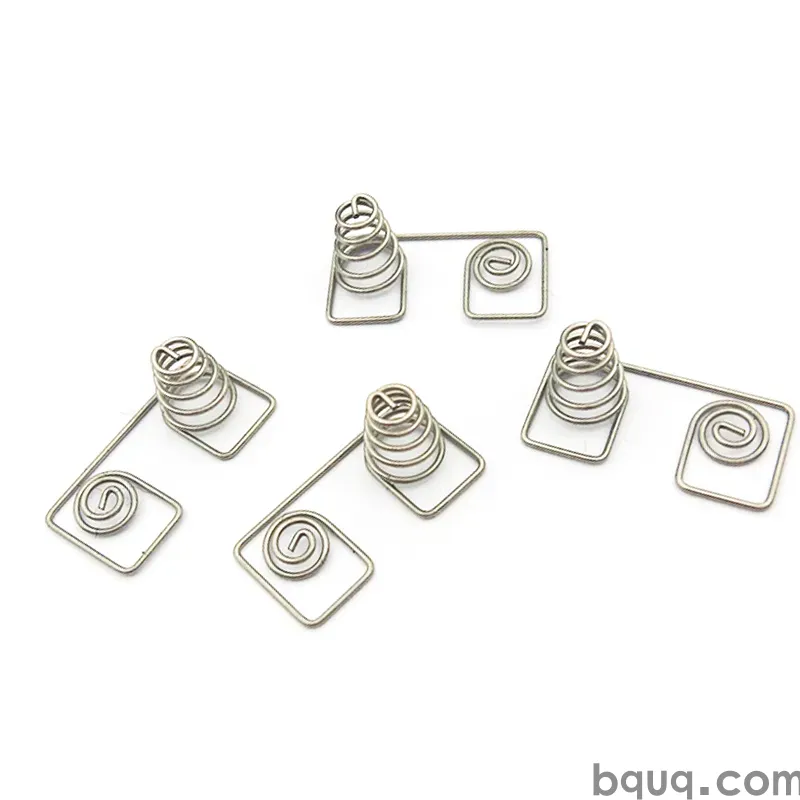
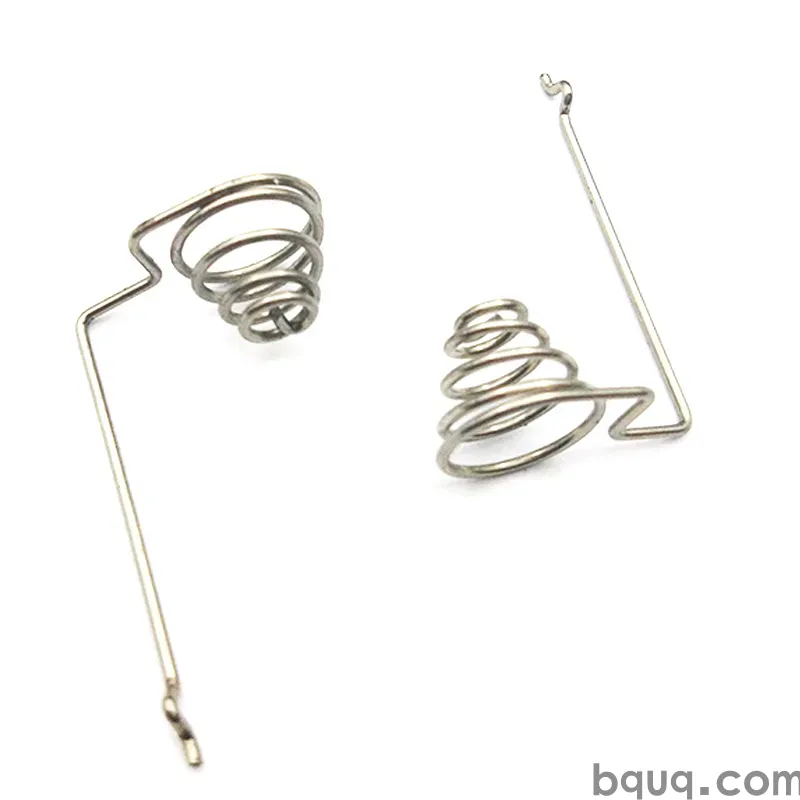
One class of stamped parts has the opposite requirement: parts that must spring back. Contact springs, shrapnel, EMI fingers, battery clips and every stamped spring contact is a springback machine by design — the die forms a shape whose elastic deflection under load creates the contact force. In those parts the die maker controls the free-state geometry precisely because the springback under deflection is the function, and the material is chosen for its elastic range and fatigue behavior rather than its formability. The design logic, materials and plating choices for that family are covered in our electronic contact springs guide; the manufacturing logic is the same one this article describes, pointed in the opposite direction.

The practical takeaway for buyers is to separate the two questions when you source a formed part. First, what does the print actually require at the functional points — angle at a mating surface, radius at a stress point, flatness across a seating area? Second, what material and temper will the factory run, because that decides the springback number the die must absorb? Send both the drawing and the material spec together; a die quoted for "stainless steel" and run on 301 hard is a die that misses angle on day one. Drawings, material grade, quantity — that is the RFQ package a die shop can price honestly, and a 12-hour quote is only honest if it is quoting the material you will actually run.

Frequently Asked Questions

Q: How much does a stamped part spring back after bending?

A: Indicatively 1–3° per 90° bend for mild steel at a radius-to-thickness ratio of one, 3–5° for annealed stainless, and up to 8–12° for hardened spring steels. Higher yield strength, larger r/t ratio and thinner sections all increase springback.

Q: Can springback be eliminated completely in stamping?

A: No, it cannot be removed — elastic recovery is a material property. It can be made negligible by bottoming or coining the bend zone, which stresses the material past yield and sets the angle, at the cost of higher tonnage and some surface marking.

Q: Do I need stamping simulation to get accurate bends?

A: Not for simple V and wipe bends — overbend tables plus a tryout iteration handle most geometry. Simulation earns its cost on long open sections, twist-sensitive channels and high-strength materials where springback varies along the part.

Q: Why did my parts change angle when the factory changed material?

A: Springback tracks yield strength. Substituting a higher-strength or harder-temper material into a die that was compensated for the original grade shifts the bend angle, sometimes by several degrees. Any material change on a formed part should trigger a die review and tryout.

Q: Who owns the springback risk on a new stamped part?

A: The die maker owns hitting the print at the agreed material and press conditions, and normally budgets one to three tryout iterations. The buyer owns specifying material grade, temper and functional angle requirements accurately — a die can only compensate for the material it is told to run.

Related Resources

Authored by the BQUQ Engineering Team. BQUQ is an ISO9001-certified source factory in Dongguan, China, running CNC machining, metal stamping, custom springs, heat sink and collet lines under one roof. Send drawings to sc@bquq.com or WhatsApp +86 13713157787 for a quote within 12 working hours. www.bquq.com


お問い合わせ見積もり
見積もりを取得する
私たちはあなたのオンライン体験を改善するためにcookieを使用しています。このウェブサイトを閲覧し続けることで、あなたはcookieの使用に同意したことになります。

Cookies

当社のサービスにアクセスまたは使用する前に、当社の利用規約およびこのポリシーをお読みください。このポリシーまたは利用規約に同意できない場合は、当社のサービスにアクセスまたは使用しないでください。欧州経済領域外の管轄区域にお住まいの場合、当社のサービスを利用することにより、利用規約に同意し、このポリシーで説明されているプライバシーに関する慣行に同意したことになります。当社は、事前通知なしにいつでもこのポリシーを変更することがあり、すでに保有している個人情報、およびポリシーが変更された後に収集された新しい個人情報に変更が適用される場合があります。変更を行う場合は、このポリシーの上部にある日付を修正して通知します。このポリシーに基づくあなたの権利に影響を与える個人情報の収集、使用、開示方法に重大な変更があった場合は、事前に通知します。欧州経済地域、英国、スイス以外の管轄区域にお住まいの場合(以下、総称して「欧州諸国」といいます)、変更通知を受け取った後も引き続き当社のサービスにアクセスまたは利用することは、更新されたポリシーに同意したことを示すものとなります。さらに、当社のサービスの特定の部分における個人情報の取り扱いに関する開示または追加情報を実際立って提供する場合があります。このような通知は、本ポリシーを補完する場合があり、また、当社がお客様の個人情報をどのように処理するかについて追加の選択肢を提供する場合があります。
CookiesCookies are small text files stored on your device when you access most Websites on the internet or open certain emails. Among other things, Cookies allow a Website to recognize your device and remember if you've been to the Website before. Examples of information collected by Cookies include your browser type and the address of the Website from which you arrived at our Website as well as IP address and clickstream behavior (that is the pages you view and the links you click).We use the term cookie to refer to Cookies and technologies that perform a similar function to Cookies (e.g., tags, pixels, web beacons, etc.). Cookies can be read by the originating Website on each subsequent visit and by any other Website that recognizes the cookie. The Website uses Cookies in order to make the Website easier to use, to support a better user experience, including the provision of information and functionality to you, as well as to provide us with information about how the Website is used so that we can make sure it is as up to date, relevant, and error free as we can. Cookies on the Website We use Cookies to personalize your experience when you visit the Site, uniquely identify your computer for security purposes, and enable us and our third-party service providers to serve ads on our behalf across the internet.We classify Cookies in the following categories: ●  Strictly Necessary Cookies ●  Performance Cookies ●  Functional Cookies ●  Targeting CookiesCookie ListA cookie is a small piece of data (text file) that a website – when visited by a user – asks your browser to store on your device in order to remember information about you, such as your language preference or login information. Those cookies are set by us and called first-party cookies. We also use third-party cookies – which are cookies from a domain different than the domain of the website you are visiting – for our advertising and marketing efforts. More specifically, we use cookies and other tracking technologies for the following purposes:Strictly Necessary CookiesThese cookies are necessary for the website to function and cannot be switched off in our systems. They are usually only set in response to actions made by you which amount to a request for services, such as setting your privacy preferences, logging in or filling in forms. You can set your browser to block or alert you about these cookies, but some parts of the site will not then work. These cookies do not store any personally identifiable information.Functional CookiesThese cookies enable the website to provide enhanced functionality and personalisation. They may be set by us or by third party providers whose services we have added to our pages. If you do not allow these cookies then some or all of these services may not function properly.Performance CookiesThese cookies allow us to count visits and traffic sources so we can measure and improve the performance of our site. They help us to know which pages are the most and least popular and see how visitors move around the site. All information these cookies collect is aggregated and therefore anonymous. If you do not allow these cookies we will not know when you have visited our site, and will not be able to monitor its performance.Targeting CookiesThese cookies may be set through our site by our advertising partners. They may be used by those companies to build a profile of your interests and show you relevant adverts on other sites. They do not store directly personal information, but are based on uniquely identifying your browser and internet device. If you do not allow these cookies, you will experience less targeted advertising.How To Turn Off CookiesYou can choose to restrict or block Cookies through your browser settings at any time. Please note that certain Cookies may be set as soon as you visit the Website, but you can remove them using your browser settings. However, please be aware that restricting or blocking Cookies set on the Website may impact the functionality or performance of the Website or prevent you from using certain services provided through the Website. It will also affect our ability to update the Website to cater for user preferences and improve performance. Cookies within Mobile ApplicationsWe only use Strictly Necessary Cookies on our mobile applications. These Cookies are critical to the functionality of our applications, so if you block or delete these Cookies you may not be able to use the application. These Cookies are not shared with any other application on your mobile device. We never use the Cookies from the mobile application to store personal information about you.If you have questions or concerns regarding any information in this Privacy Policy, please contact us by email at . You can also contact us via our customer service at our Site.