ブログ

Stamping vs CNC Machining: The Volume Line That Decides
Jan 25,2026

Stamping vs CNC Machining: The Volume Line That Decides

Short answer: stamping wins the unit-cost race once volume is high enough to absorb the die, and CNC machining wins below that line. For a typical stamped bracket or terminal, the crossover usually sits between roughly 1,000 and 5,000 pieces per year. Below it, machining is usually cheaper per part and needs no tooling; above it, a progressive die pays for itself fast and drops unit price to a fraction of machined cost. Part size, tolerance, material and geometry decide exactly where the line lands.

The question is not which process is better. It is which process your quantity, tolerance and geometry support. BQUQ runs both lines — CNC turning and milling, plus metal stamping — in one ISO9001 factory in Dongguan, so the comparison below is not a sales pitch for one process. It is the same cost logic we apply when a drawing arrives and we have to recommend the route that protects your budget and your delivery date.

Two Processes That Answer Different Questions

CNC machining removes material from a solid block or bar. Every part is cut individually, which makes the process flexible: no tooling commitment, fast design changes, and tight tolerances down to ±0.005 mm on critical features. The cost is time — each piece needs minutes of spindle time, so unit price stays high.

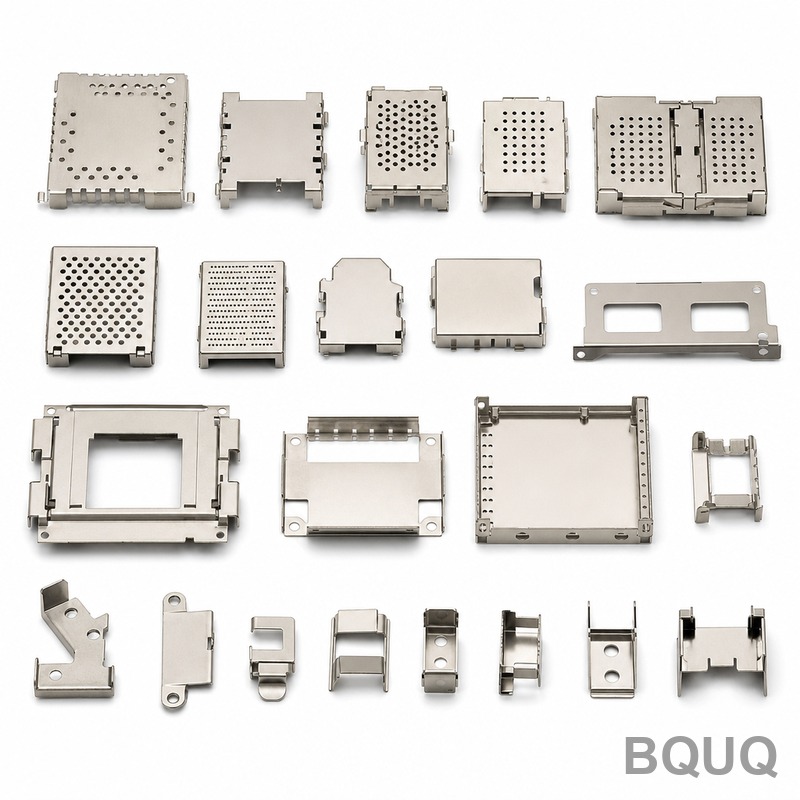
Stamping shapes sheet metal with a die in a single stroke or a rapid series of strokes. The die is expensive and slow to build, but once it runs, parts come out in fractions of a second. Unit cost collapses, but every design change means a die change, and tolerance is limited by what a die can hold repeatably.

Decision inputCNC machiningStamping
Tooling investmentLow (fixtures only, often none)High (die: $2k–$50k+ typical)
Unit cost shapeFlat, quantity-insensitiveFalls steeply with volume
Design-change costLow, edit the programHigh, rebuild or modify the die
Typical tolerance±0.01–0.05 mm routine; ±0.005 mm on CNC criticals±0.05–0.13 mm standard; ±0.02 mm with precision progressive dies
Part size sweet spotSmall to medium, 3D shapesThin flat or formed parts, small to large
Speed per partMinutesFractions of a second

The takeaway from the table: stamping is a volume business and CNC is a flexibility business. A factory that only offers one of them will quietly steer you toward what it sells; a factory that runs both, as we do, can be blunt about which route actually fits your drawing.

What a Die Really Costs

Tooling is the entire argument for CNC at low volume. A simple blanking die might cost $2,000–$8,000. A progressive die for a small terminal with 8–15 stations typically runs $5,000–$25,000. A large, high-speed progressive die for an automotive part can exceed $50,000. Die lead time runs 4–10 weeks depending on complexity, while a CNC first article can ship in days.

Volume per yearTypical sensible routeWhy
1–100 pcsCNC machiningNo tooling cost, parts in days
100–1,000 pcsCNC, or soft tooling if repeat ordersDie rarely pays back at this volume
1,000–10,000 pcsStamping with a simple or progressive dieCrossover zone; model both quotes
10,000+ pcsProgressive die stampingUnit cost typically 1/3–1/10 of machined
100,000+ pcsHigh-speed progressive, multi-out diesStamping cost becomes material-dominated

The takeaway: amortize the die over your annual quantity before comparing unit prices. If you need 500 pieces a year for five years, a $15,000 die adds $6 per part before a single stamping stroke — CNC will almost always win that argument.

Tolerance and Geometry: Where CNC Cannot Be Replaced

Stamping holds position well but has honest limits. Blanked edges are sheared, not cut: expect a burnished band with a break zone, typically 20–40% of thickness sheared and the rest fractured. Fine blanking smooths that edge, but adds cost. Formed features spring back, so bend angles carry looser tolerances than holes do, and tight flatness over large areas is hard to hold in a die.

CNC earns its place when the part is thick, has 3D features, demands tight roundness or threads, or needs ±0.005 mm class precision — none of which a stamping die delivers economically. A CNC-machined component that started life as a stamped design is common precisely because the designer discovered one feature that a die cannot hold.

FeatureStamping typicalCNC typical
Hole position±0.05–0.10 mm±0.01–0.03 mm
Blanked profile±0.05–0.13 mm±0.01–0.05 mm
Bend angle±0.5–1°±0.1–0.3°
ThreadsSecondary tapping onlyCut or rolled in-process
Edge conditionShear + break zoneClean machined surface
Material thickness0.05–6 mm typical, sheet onlyUp to solid bar stock

The takeaway is that geometry, not just volume, sets the floor: a part that is really a small 3D block is not a stamping candidate at any volume, while a thin connector terminal is rarely economical to machine at any volume above a few thousand pieces.

The Hybrid Answer

The sharpest designs split the difference: stamp the body where the volume economics work, then add one machined feature that stamping cannot hold. A stamped busbar gets CNC-machined mounting holes and a milled contact face; a stamped bracket gets a tapped hole added in a secondary operation; a stamped terminal gets a CNC-machined mating surface where wear matters.

Because we run stamping and CNC under one roof, hybrid parts move between lines without a second supplier, and inspection reports cover both processes. That is the practical answer when your drawing has ten easy features and one impossible one: die the ten, machine the one.

How to Decide Before You Quote

Run the arithmetic yourself in five steps. First, fix your real annual quantity and how many years the part will live. Second, get a die quote and a CNC per-part quote for the same drawing. Third, divide tooling cost by quantity and add it to the stamped unit price. Fourth, check the tolerance and edge-condition callouts — if any feature is below stamping's practical limit, add secondary cost or switch to hybrid. Fifth, compare lead times: a die build adds weeks to your first shipment, so if the launch is urgent, machining wins the first order even when stamping wins the second.

When the numbers are close, quality risk tips the scale. A stamped part's consistency depends on die maintenance and material temper; a machined part's depends on setup and tool wear. Ask any factory for its standard dimensional report — at BQUQ each batch ships with inspection data under our ISO9001 system, whether the parts came off the press line or the CNC line.

Have a drawing? Get a factory quote within 12 hours.
Email sc@bquq.com or WhatsApp +86 137 1315 7787 with your PDF/DXF/STEP file. An engineer reviews it and replies with price, lead time and DFM notes on working days.

Frequently Asked Questions

Q: At what quantity is stamping cheaper than CNC machining?

For most small parts the crossover sits between roughly 1,000 and 5,000 pieces per year, once die cost is amortized. Large or thick parts shift it upward, tiny high-speed terminals shift it down. Model both quotes with tooling amortized.

Q: Can stamping hold CNC-level tolerances?

Not generally. Standard stamping holds ±0.05–0.13 mm; precision progressive dies reach about ±0.02 mm on position. CNC routinely holds ±0.01 mm and reaches ±0.005 mm on critical features. Specify stamping tolerances only where the die can repeat them.

Q: What if my volume is below the crossover but will grow?

Machine the first batches for fast delivery and design freeze, then move to a die once the design stabilizes and volume justifies it. Stamping tooling built too early locks in a design you may still change, and die modifications are expensive.

Q: Is a stamped part weaker than a machined one?

Not inherently — the material is the same. But blanked edges have a fractured zone and formed corners are work-hardened and stressed, so fatigue and edge quality differ. For load-bearing edges, specify fine blanking or machining where the shear break is unacceptable.

Q: Which process should a factory recommend when it runs both?

The one that fits the drawing: quantity, tolerance, geometry and schedule. A factory that pushes stamping on a 200-piece part or CNC on a 200,000-piece terminal is selling its capacity, not your part. Ask for the cost logic, not the preference.

Authored by the BQUQ Engineering Team. BQUQ is an ISO9001-certified source factory in Dongguan, China, running CNC machining, metal stamping, custom springs, heat sink and collet lines under one roof. Send drawings to sc@bquq.com or WhatsApp +86 13713157787 for a quote within 12 working hours. www.bquq.com


お問い合わせ見積もり
見積もりを取得する
私たちはあなたのオンライン体験を改善するためにcookieを使用しています。このウェブサイトを閲覧し続けることで、あなたはcookieの使用に同意したことになります。

Cookies

当社のサービスにアクセスまたは使用する前に、当社の利用規約およびこのポリシーをお読みください。このポリシーまたは利用規約に同意できない場合は、当社のサービスにアクセスまたは使用しないでください。欧州経済領域外の管轄区域にお住まいの場合、当社のサービスを利用することにより、利用規約に同意し、このポリシーで説明されているプライバシーに関する慣行に同意したことになります。当社は、事前通知なしにいつでもこのポリシーを変更することがあり、すでに保有している個人情報、およびポリシーが変更された後に収集された新しい個人情報に変更が適用される場合があります。変更を行う場合は、このポリシーの上部にある日付を修正して通知します。このポリシーに基づくあなたの権利に影響を与える個人情報の収集、使用、開示方法に重大な変更があった場合は、事前に通知します。欧州経済地域、英国、スイス以外の管轄区域にお住まいの場合(以下、総称して「欧州諸国」といいます)、変更通知を受け取った後も引き続き当社のサービスにアクセスまたは利用することは、更新されたポリシーに同意したことを示すものとなります。さらに、当社のサービスの特定の部分における個人情報の取り扱いに関する開示または追加情報を実際立って提供する場合があります。このような通知は、本ポリシーを補完する場合があり、また、当社がお客様の個人情報をどのように処理するかについて追加の選択肢を提供する場合があります。
CookiesCookies are small text files stored on your device when you access most Websites on the internet or open certain emails. Among other things, Cookies allow a Website to recognize your device and remember if you've been to the Website before. Examples of information collected by Cookies include your browser type and the address of the Website from which you arrived at our Website as well as IP address and clickstream behavior (that is the pages you view and the links you click).We use the term cookie to refer to Cookies and technologies that perform a similar function to Cookies (e.g., tags, pixels, web beacons, etc.). Cookies can be read by the originating Website on each subsequent visit and by any other Website that recognizes the cookie. The Website uses Cookies in order to make the Website easier to use, to support a better user experience, including the provision of information and functionality to you, as well as to provide us with information about how the Website is used so that we can make sure it is as up to date, relevant, and error free as we can. Cookies on the Website We use Cookies to personalize your experience when you visit the Site, uniquely identify your computer for security purposes, and enable us and our third-party service providers to serve ads on our behalf across the internet.We classify Cookies in the following categories: ●  Strictly Necessary Cookies ●  Performance Cookies ●  Functional Cookies ●  Targeting CookiesCookie ListA cookie is a small piece of data (text file) that a website – when visited by a user – asks your browser to store on your device in order to remember information about you, such as your language preference or login information. Those cookies are set by us and called first-party cookies. We also use third-party cookies – which are cookies from a domain different than the domain of the website you are visiting – for our advertising and marketing efforts. More specifically, we use cookies and other tracking technologies for the following purposes:Strictly Necessary CookiesThese cookies are necessary for the website to function and cannot be switched off in our systems. They are usually only set in response to actions made by you which amount to a request for services, such as setting your privacy preferences, logging in or filling in forms. You can set your browser to block or alert you about these cookies, but some parts of the site will not then work. These cookies do not store any personally identifiable information.Functional CookiesThese cookies enable the website to provide enhanced functionality and personalisation. They may be set by us or by third party providers whose services we have added to our pages. If you do not allow these cookies then some or all of these services may not function properly.Performance CookiesThese cookies allow us to count visits and traffic sources so we can measure and improve the performance of our site. They help us to know which pages are the most and least popular and see how visitors move around the site. All information these cookies collect is aggregated and therefore anonymous. If you do not allow these cookies we will not know when you have visited our site, and will not be able to monitor its performance.Targeting CookiesThese cookies may be set through our site by our advertising partners. They may be used by those companies to build a profile of your interests and show you relevant adverts on other sites. They do not store directly personal information, but are based on uniquely identifying your browser and internet device. If you do not allow these cookies, you will experience less targeted advertising.How To Turn Off CookiesYou can choose to restrict or block Cookies through your browser settings at any time. Please note that certain Cookies may be set as soon as you visit the Website, but you can remove them using your browser settings. However, please be aware that restricting or blocking Cookies set on the Website may impact the functionality or performance of the Website or prevent you from using certain services provided through the Website. It will also affect our ability to update the Website to cater for user preferences and improve performance. Cookies within Mobile ApplicationsWe only use Strictly Necessary Cookies on our mobile applications. These Cookies are critical to the functionality of our applications, so if you block or delete these Cookies you may not be able to use the application. These Cookies are not shared with any other application on your mobile device. We never use the Cookies from the mobile application to store personal information about you.If you have questions or concerns regarding any information in this Privacy Policy, please contact us by email at . You can also contact us via our customer service at our Site.