ブログ

Battery Contact Springs: Sizing Force for Vibration, Corrosion and Life
Dec 14,2025

Battery Contact Springs: Sizing Force for Vibration, Corrosion and Life

A battery contact spring fails in three ways: too little force (the cell rattles, contact resistance climbs and the device browns out), corrosion (the spring rusts or the plating wears and resistance spikes), and fatigue or set after too few cycles. The design answer is a normal force of roughly 1–5 N for most consumer battery contacts, a spring steel or stainless that holds that force without permanent set, and plating that survives the environment — nickel for economy, gold for low-voltage reliability.

Battery contacts look like the simplest spring job in electronics — a little coiled or stamped spring that touches a cell terminal. But the forces at stake are subtle: the cell must stay seated through drop and vibration, the contact must carry current without heating, and the whole assembly must still work after years of battery changes, humidity and temperature swing. Every field failure I have traced came back to one of three decisions made early: force too low, material wrong for the environment, or life never tested.

Sizing Normal Force: The Vibration and Resistance Trade

Normal force at the contact point does two jobs: it holds the cell mechanically and it keeps contact resistance low electrically. Both need more force than intuition suggests. A spring that merely touches the terminal passes a bench test and fails on a drop table — vibration momentarily separates the contact and the electronics reset. Below roughly 1 N of force, contact resistance becomes unstable and micro-arcs erode the surface. Above 5 N, battery insertion gets stiff and the user complains, and the spring works harder against its own set limit.

ApplicationTypical normal forceNotes
Coin cell holder, low current0.5–2 NSmall springs, watch contact resistance
AA/AAA battery terminal2–5 NMust survive drop and insertion
Power tool / high-current pack5–15 NContact heating drives force up
Spring probe / test contact1–3 NHigh cycle life dominates
Automotive module, vibration3–8 NVibration keeps force demand high

Typical ranges for commercial products. Takeaway: size the force from the worst case — highest vibration, highest current, lowest temperature — not the bench case. Then verify the spring delivers that force at its working height with manufacturing tolerances stacked against you, not at nominal. A force spec of "2 N minimum at working height" is worth more than a free-length dimension, because free length is only a proxy for what the contact actually feels.

Material: Force Retention and Corrosion Are Linked

Battery environments are corrosive by nature: humidity, finger salts from battery changes, and outgassing or electrolyte residue in the worst cases. The material must hold its force over the product life while resisting that environment. Carbon spring steel is strong and cheap but rusts; stainless is corrosion-safe but weaker as a spring and less conductive; plated options sit in between.

MaterialForce retentionCorrosion behaviorConductivityTypical use
Music wire, nickel platedGoodNeeds plating; rusts if plating wearsGoodEconomy contacts, dry products
Stainless 302/304GoodExcellent unplatedPoorCorrosion-critical, signal current
Beryllium copperExcellentGood, often platedGoodPrecision, high-cycle, small space
Phosphor bronzeGoodGood, tarnishesGoodStamped contacts, battery strips
Spring steel, gold flashedGoodPlating-dependentGoodLow-voltage, low-current reliability

Takeaway: if the device is low-voltage and low-current — the majority of consumer electronics — corrosion resistance matters more than conductivity, because a few milliohms of oxide is noise compared to a dead contact. For a 3 V circuit, specify plated spring steel or beryllium copper with a real plating thickness; bare music wire belongs in dry, sealed products. Where the spring doubles as a stamped battery strip, the torsion or leaf form often replaces a coil to save height, and the same force-and-set logic applies to the bent section.

Corrosion and Plating: The Resistance Story Over Time

Contact resistance in a battery circuit is a story about the surface over time. Fresh metal measures fine; the question is what the surface looks like after 18 months. Nickel plating on spring steel gives a hard, corrosion-resistant surface at modest cost and is the workhorse for consumer battery contacts. Gold adds low and stable resistance for low-voltage circuits where every milliohm counts. The plating must survive the flexing of the spring — plating that cracks at the bend exposes bare steel, and the corrosion starts exactly where the current flows.

PlatingTypical thicknessStrengthWeakness
Nickel (electrolytic)2–5 µmCheap, hard, corrosion barrierHigher contact resistance than gold
Gold flash over nickel0.1–0.5 µm AuStable low resistanceThin — wears with repeated insertion
Hard gold over nickel0.5–1.5 µm AuLong wear lifeCost
Tin2–5 µmGood for power, solderableFretting under motion
None (stainless)Zero plating costHigh resistance — needs force and wiping

Takeaway: pair the plating with the expected insertion count. A battery contact inserted a few hundred times over its life tolerates flash gold or nickel; a contact that sees thousands of insertions needs hard gold thickness on the wear track. Whatever the finish, specify the plating on the drawing and test contact resistance after life, not just fresh — the contact spring guide covers the same logic for connectors generally, and it applies double here because batteries come with vibration and salts built in.

Life and Set: Designing the Spring to Still Push at End of Life

Battery contacts take a beating: repeated insertion forces the spring past its working deflection, temperature cycles relax it, and every insertion bends the flexing section. The two life-limiting mechanisms are permanent set (the spring takes a bend and stops pushing) and fatigue (cracks at the bend radius). Design the working stress so the spring stays elastic at maximum insertion deflection — as a rule of thumb keep the maximum bending stress below roughly 60–75% of the material yield for stamped springs, and verify by inserting production samples hundreds of times and re-measuring force. Relaxation and fatigue are different failures with different fixes, and battery contacts suffer both.

The verification loop is short and worth doing on every new contact: measure force at working height on samples, run insertion or deflection cycles to the target life, then measure force retention and contact resistance on the survivors. A contact that loses 30% of its force after 500 insertions will fail in year two even if it passes today. Ask the factory for that data on the sample batch before you approve tooling.

BQUQ designs and builds battery contact springs under ISO9001 in Dongguan, from coiled compression springs to stamped extension and leaf forms, with plating arranged to your spec and batch force testing as standard. Send the drawing with the current, the expected insertion count and the environment to sc@bquq.com or WhatsApp +86 13713157787 — the quotation comes back within 12 working hours, with the force target and material recommendation stated on it.

Have a drawing? Get a factory quote within 12 hours.
Email sc@bquq.com or WhatsApp +86 137 1315 7787 with your PDF/DXF/STEP file. An engineer reviews it and replies with price, lead time and DFM notes on working days.

Q: How much force does a battery contact spring really need?

For consumer cells, target 2–5 N at working height so the contact survives drops without intermittent power loss. Higher current or stronger vibration pushes the band up; coin cells with tiny springs can work at 0.5–2 N if resistance is verified.

Q: Should battery contact springs be stainless or plated spring steel?

If the product is low-voltage and sees humidity, stainless avoids the plating-wear failure mode entirely but needs higher force for its resistance. If cost and conductivity dominate, use plated spring steel with nickel or gold at a thickness matched to the insertion count.

Q: Why does my battery contact work new but fail after a year?

Either the spring took a permanent set and lost force, or the plating wore and corrosion raised the resistance. Measure force and resistance on aged samples — a force drop points to set and design stress, a resistance rise points to surface wear and plating.

Q: What is the life target for battery contact springs?

Match it to the product: sealed consumer devices often pass with a few hundred insertions, while chargers, test sockets and tool battery packs need 5,000–50,000 cycles. Define the end point as a force or resistance threshold, then test to it.

Q: Can a battery contact be coiled or stamped — which is better?

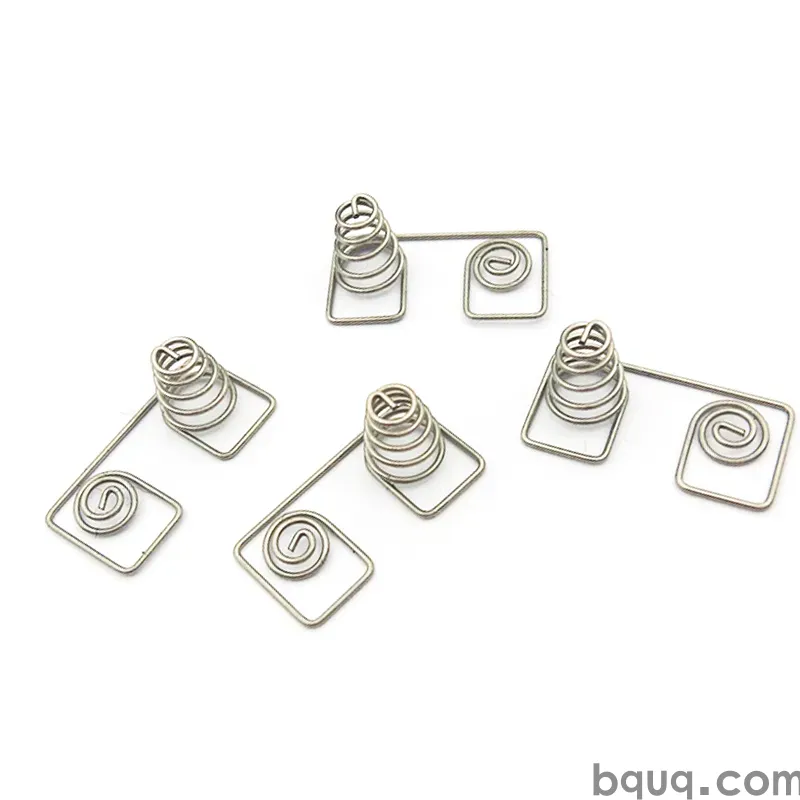
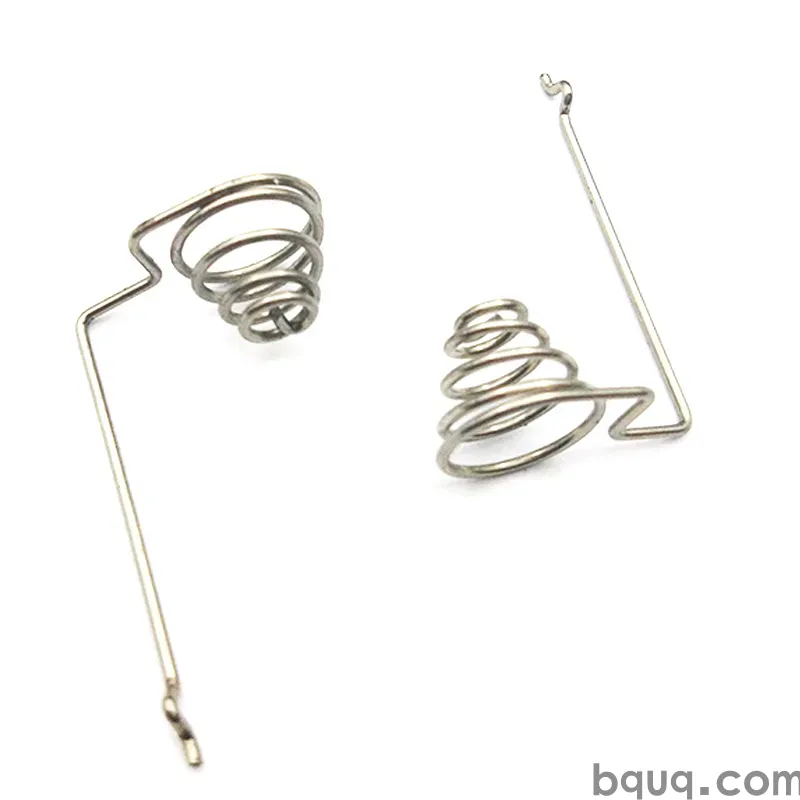
Both work. Coiled contacts (often compression springs) suit round cells and axial force; stamped and formed contacts suit flat packs, low height and integration into a terminal strip. Stamping wins at volume and part integration; coiling wins for round geometry and small quantities without die cost.

Authored by the BQUQ Engineering Team. BQUQ is an ISO9001-certified source factory in Dongguan, China, running CNC machining, metal stamping, custom springs, heat sink and collet lines under one roof. Send drawings to sc@bquq.com or WhatsApp +86 13713157787 for a quote within 12 working hours. www.bquq.com


お問い合わせ見積もり
見積もりを取得する
私たちはあなたのオンライン体験を改善するためにcookieを使用しています。このウェブサイトを閲覧し続けることで、あなたはcookieの使用に同意したことになります。

Cookies

当社のサービスにアクセスまたは使用する前に、当社の利用規約およびこのポリシーをお読みください。このポリシーまたは利用規約に同意できない場合は、当社のサービスにアクセスまたは使用しないでください。欧州経済領域外の管轄区域にお住まいの場合、当社のサービスを利用することにより、利用規約に同意し、このポリシーで説明されているプライバシーに関する慣行に同意したことになります。当社は、事前通知なしにいつでもこのポリシーを変更することがあり、すでに保有している個人情報、およびポリシーが変更された後に収集された新しい個人情報に変更が適用される場合があります。変更を行う場合は、このポリシーの上部にある日付を修正して通知します。このポリシーに基づくあなたの権利に影響を与える個人情報の収集、使用、開示方法に重大な変更があった場合は、事前に通知します。欧州経済地域、英国、スイス以外の管轄区域にお住まいの場合(以下、総称して「欧州諸国」といいます)、変更通知を受け取った後も引き続き当社のサービスにアクセスまたは利用することは、更新されたポリシーに同意したことを示すものとなります。さらに、当社のサービスの特定の部分における個人情報の取り扱いに関する開示または追加情報を実際立って提供する場合があります。このような通知は、本ポリシーを補完する場合があり、また、当社がお客様の個人情報をどのように処理するかについて追加の選択肢を提供する場合があります。
CookiesCookies are small text files stored on your device when you access most Websites on the internet or open certain emails. Among other things, Cookies allow a Website to recognize your device and remember if you've been to the Website before. Examples of information collected by Cookies include your browser type and the address of the Website from which you arrived at our Website as well as IP address and clickstream behavior (that is the pages you view and the links you click).We use the term cookie to refer to Cookies and technologies that perform a similar function to Cookies (e.g., tags, pixels, web beacons, etc.). Cookies can be read by the originating Website on each subsequent visit and by any other Website that recognizes the cookie. The Website uses Cookies in order to make the Website easier to use, to support a better user experience, including the provision of information and functionality to you, as well as to provide us with information about how the Website is used so that we can make sure it is as up to date, relevant, and error free as we can. Cookies on the Website We use Cookies to personalize your experience when you visit the Site, uniquely identify your computer for security purposes, and enable us and our third-party service providers to serve ads on our behalf across the internet.We classify Cookies in the following categories: ●  Strictly Necessary Cookies ●  Performance Cookies ●  Functional Cookies ●  Targeting CookiesCookie ListA cookie is a small piece of data (text file) that a website – when visited by a user – asks your browser to store on your device in order to remember information about you, such as your language preference or login information. Those cookies are set by us and called first-party cookies. We also use third-party cookies – which are cookies from a domain different than the domain of the website you are visiting – for our advertising and marketing efforts. More specifically, we use cookies and other tracking technologies for the following purposes:Strictly Necessary CookiesThese cookies are necessary for the website to function and cannot be switched off in our systems. They are usually only set in response to actions made by you which amount to a request for services, such as setting your privacy preferences, logging in or filling in forms. You can set your browser to block or alert you about these cookies, but some parts of the site will not then work. These cookies do not store any personally identifiable information.Functional CookiesThese cookies enable the website to provide enhanced functionality and personalisation. They may be set by us or by third party providers whose services we have added to our pages. If you do not allow these cookies then some or all of these services may not function properly.Performance CookiesThese cookies allow us to count visits and traffic sources so we can measure and improve the performance of our site. They help us to know which pages are the most and least popular and see how visitors move around the site. All information these cookies collect is aggregated and therefore anonymous. If you do not allow these cookies we will not know when you have visited our site, and will not be able to monitor its performance.Targeting CookiesThese cookies may be set through our site by our advertising partners. They may be used by those companies to build a profile of your interests and show you relevant adverts on other sites. They do not store directly personal information, but are based on uniquely identifying your browser and internet device. If you do not allow these cookies, you will experience less targeted advertising.How To Turn Off CookiesYou can choose to restrict or block Cookies through your browser settings at any time. Please note that certain Cookies may be set as soon as you visit the Website, but you can remove them using your browser settings. However, please be aware that restricting or blocking Cookies set on the Website may impact the functionality or performance of the Website or prevent you from using certain services provided through the Website. It will also affect our ability to update the Website to cater for user preferences and improve performance. Cookies within Mobile ApplicationsWe only use Strictly Necessary Cookies on our mobile applications. These Cookies are critical to the functionality of our applications, so if you block or delete these Cookies you may not be able to use the application. These Cookies are not shared with any other application on your mobile device. We never use the Cookies from the mobile application to store personal information about you.If you have questions or concerns regarding any information in this Privacy Policy, please contact us by email at . You can also contact us via our customer service at our Site.