ブログ

Swiss Collet Systems: 2J, 16C and the Guide Bushing Question
Jun 08,2026

Swiss Collet Systems: 2J, 16C and the Guide Bushing Question

A Swiss collet system has two separate jobs: the spindle collet must grip the bar so it can be fed and rotated, and the guide bushing must support that same bar exactly where the tools cut. The 2J and 16C families are the two collet systems you will meet most often on Swiss-type and automatic lathes, and choosing between them is mostly a question of bar diameter, machine spindle design and how much axial length control you need.

Before any cutting happens, a Swiss-type lathe decides how the raw bar is held. The bar rides in a rotating spindle collet, which grips, releases and feeds it. Behind the tools, a guide bushing closes the support gap so a slender bar does not bend or whip under the cut. Get both right and the machine holds its natural precision; get either wrong and nothing downstream — tooling, speeds, coolant — can save the part. This guide walks through the two collet systems, then answers the guide bushing question that every setup engineer eventually asks.

What a "Collet System" Actually Means

A collet system is more than the collet itself. It is the complete chain: collet body, chuck or adapter that seats it in the spindle, closing nut or draw tube, and the bore geometry that matches your stock. Buy the collet without checking the chuck and you have a paperweight. The system number — 2J, 16C, 5C, 3J — defines the collet body shape, thread or taper, and therefore which chucks and adapters it fits.

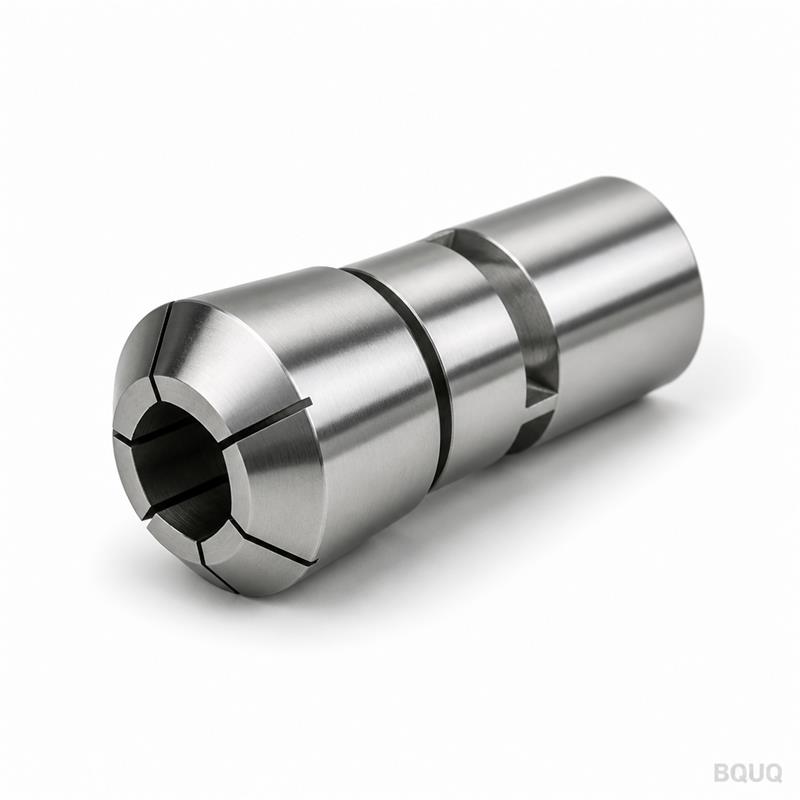
Two facts matter when you compare systems. First, the number defines the interface family, not your bar size: a 2J collet exists in bores from roughly 3 mm up to about 38 mm. Second, collets of the same system are interchangeable across chucks built for that system, which is why whole job shops standardize on one family and buy spare collets instead of spare chucks. The collet materials also matter — good collets are machined from hardened alloy or spring steel, ground on the gripping bore, and slit so the segments collapse evenly. That is exactly how BQUQ machines its auto-lathe collets: CNC turned and milled from hardened alloy steel, then heat treated, with the bore held to a 0.005 mm class.

2J vs 16C: The Two Swiss Workhorses

The 2J collet is the classic Swiss and automatic lathe workholding collet — short body, compact taper, built for machines where the spindle is also the feed mechanism. The 16C family is the older, larger American system, also used on Swiss-type machines but far more common on conventional CNC lathes and screw machines with collet chucks. Typical catalog maximums for round bar are the first filter:

Collet systemTypical max round barTypical inch stepWhere you see it most
5C~27 mm (1-1/16 in)1/64 inManual and CNC lathes, toolroom
16C~41 mm (1-5/8 in)1/64 inCNC lathes, screw machines, larger Swiss work
2J~38 mm (1-1/2 in)1/64 inSwiss-type lathes, automatics, compact spindles
3J~51 mm (2 in)1/64 inHeavy automatic and multi-spindle work

These are catalog maxima, not recommendations — grip quality falls off as you approach the top of any collet's range, and hex or square bores always sacrifice capacity (typically 10–25%) because of corner geometry. The takeaway: pick the smallest system that covers your largest stock diameter, then size the bore to the actual bar.

Below the maximum, the choice is driven by the machine. A 2J system's shorter body suits the tight spindle envelope of a Swiss machine and leaves more room for the feed mechanism; a 16C system offers larger capacity and a very deep installed base of chucks and adapters. If you are equipping a new Swiss-type collet chuck line, ask two questions: what spindle nose does the machine carry, and what is the largest bar diameter you will ever run? The answer usually picks the family for you.

The Guide Bushing Question: Fixed or Sliding

Now the part of Swiss machining that confuses people coming from conventional lathes. On a sliding-headstock Swiss machine the headstock moves, pushing the bar through a guide bushing mounted near the tool zone. That bushing carries the real workholding burden during the cut: it positions the bar within fractions of a hundredth of a millimeter of the tools. Fixed and sliding refer to how the bushing is mounted.

With a fixed (stationary) bushing, the bushing is anchored to the machine frame and the bar slides through it; this is the classic arrangement that gives Swiss machines their famous support for long, slender parts. With a sliding (moving) bushing, the bushing is carried with the headstock, so the support point travels with the bar — a layout used on machines that need longer main-spindle travel or want to machine features farther from the bushing face without losing support. The differences are covered in depth in our guide to fixed vs sliding guide bushings; the short version is in the table:

FactorFixed bushingSliding bushing
Support pointStationary, at the tool zoneTravels with the headstock
Typical clearance to barSmall, ~0.003–0.008 mm typicalOften opened up, ~0.01–0.02 mm typical
Best forLong slender parts, high L/D, fine finishLonger main-spindle stroke, heavier roughing
Wear patternBushing bore wears at the cut zoneWear spread over bushing travel
Setup costLow, but bushing must be closely sizedHigher, more moving parts to align

Clearance numbers are typical operating ranges, not specifications — the right figure depends on bar diameter, material and spindle speed. Whatever the type, the bushing bore must be sized close to the actual stock: too loose and the bar flexes and marks finish; too tight and it seizes or scorches.

Choosing and Maintaining the Bushing

Guide bushings are consumables with a long but finite life, and their material choice follows the economics of your run:

Bushing typeTypical life driverCost levelTypical use
Hardened tool steel, plainAbrasive wearLowestShort runs, soft materials
Tungsten carbide, solidWear and chippingHighLong runs, abrasive alloys
Carbide with replaceable linerLiner replacementMedium per cycleHigh-volume jobs, quick turnaround
Split or adjustable bushingFine tuning of clearanceMediumTight-clearance precision work

A worn bushing shows up first as a raised band on the bar, a dulling finish, or drifting size at the front of the part. Check the bushing bore with the bar removed whenever you change jobs, and replace the bushing before it scores the stock — rescuing a run of scratched parts costs more than any bushing. Our guide bushing article covers inspection intervals and wear diagnosis in more detail.

Where the System Meets the Factory

A collet system only performs as well as the parts it is built from. The collet body must be concentric to the taper it seats in, the bore must match the stock within a few hundredths of a millimeter, and the hardened segments must flex evenly for thousands of cycles. That is why BQUQ machines collets and chucks on CNC turning and milling centers with ±0.005 mm capability, then verifies bores on every batch rather than sampling one. If you are outfitting a Swiss line — collets, chucks, or a complete 2J chuck setup — send the stock sizes and spindle details to the BQUQ engineering team and get a quotation within 12 working hours.

Have a drawing? Get a factory quote within 12 hours.
Email sc@bquq.com or WhatsApp +86 137 1315 7787 with your PDF/DXF/STEP file. An engineer reviews it and replies with price, lead time and DFM notes on working days.

Frequently Asked Questions

Q: What is the difference between a 2J and a 16C collet?

A: They are different body and taper families. 2J is a shorter system common on Swiss-type and automatic lathes, typically covering round bar to about 38 mm; 16C is the larger American system, typically to about 41 mm, common on CNC lathes. The chuck decides which you need.

Q: Does a collet system number tell me the bar capacity?

A: No. The system number identifies the interface family and roughly its maximum, but actual capacity depends on the bore you order. A 2J collet is available from small bores up to about 38 mm, so you always specify bore size separately.

Q: Why does a Swiss lathe need a guide bushing when a conventional lathe does not?

A: Because the headstock slides and the bar is unsupported between spindle and tools. The bushing supports the bar at the cut zone, preventing deflection and vibration that would ruin slender parts. Conventional lathes hold short rigid stock in a chuck instead.

Q: Fixed or sliding bushing — which gives better roundness?

A: Fixed bushings generally give the tightest support because the bar is guided immediately at the tools, which is why they dominate precision Swiss work. Sliding bushing machines trade some of that for longer travel and flexibility. Roundness results depend on setup either way.

Q: How closely must the bushing bore match the bar diameter?

A: Typically within a few microns to about 0.02 mm depending on bar size and bushing type. Too loose causes flex and marks; too tight causes seizing and heat. Order bushings sized to the measured stock, not the nominal size.

Authored by the BQUQ Engineering Team. BQUQ is an ISO9001-certified source factory in Dongguan, China, running CNC machining, metal stamping, custom springs, heat sink and collet lines under one roof. Send drawings to sc@bquq.com or WhatsApp +86 13713157787 for a quote within 12 working hours. www.bquq.com


お問い合わせ見積もり
見積もりを取得する
私たちはあなたのオンライン体験を改善するためにcookieを使用しています。このウェブサイトを閲覧し続けることで、あなたはcookieの使用に同意したことになります。

Cookies

当社のサービスにアクセスまたは使用する前に、当社の利用規約およびこのポリシーをお読みください。このポリシーまたは利用規約に同意できない場合は、当社のサービスにアクセスまたは使用しないでください。欧州経済領域外の管轄区域にお住まいの場合、当社のサービスを利用することにより、利用規約に同意し、このポリシーで説明されているプライバシーに関する慣行に同意したことになります。当社は、事前通知なしにいつでもこのポリシーを変更することがあり、すでに保有している個人情報、およびポリシーが変更された後に収集された新しい個人情報に変更が適用される場合があります。変更を行う場合は、このポリシーの上部にある日付を修正して通知します。このポリシーに基づくあなたの権利に影響を与える個人情報の収集、使用、開示方法に重大な変更があった場合は、事前に通知します。欧州経済地域、英国、スイス以外の管轄区域にお住まいの場合(以下、総称して「欧州諸国」といいます)、変更通知を受け取った後も引き続き当社のサービスにアクセスまたは利用することは、更新されたポリシーに同意したことを示すものとなります。さらに、当社のサービスの特定の部分における個人情報の取り扱いに関する開示または追加情報を実際立って提供する場合があります。このような通知は、本ポリシーを補完する場合があり、また、当社がお客様の個人情報をどのように処理するかについて追加の選択肢を提供する場合があります。
CookiesCookies are small text files stored on your device when you access most Websites on the internet or open certain emails. Among other things, Cookies allow a Website to recognize your device and remember if you've been to the Website before. Examples of information collected by Cookies include your browser type and the address of the Website from which you arrived at our Website as well as IP address and clickstream behavior (that is the pages you view and the links you click).We use the term cookie to refer to Cookies and technologies that perform a similar function to Cookies (e.g., tags, pixels, web beacons, etc.). Cookies can be read by the originating Website on each subsequent visit and by any other Website that recognizes the cookie. The Website uses Cookies in order to make the Website easier to use, to support a better user experience, including the provision of information and functionality to you, as well as to provide us with information about how the Website is used so that we can make sure it is as up to date, relevant, and error free as we can. Cookies on the Website We use Cookies to personalize your experience when you visit the Site, uniquely identify your computer for security purposes, and enable us and our third-party service providers to serve ads on our behalf across the internet.We classify Cookies in the following categories: ●  Strictly Necessary Cookies ●  Performance Cookies ●  Functional Cookies ●  Targeting CookiesCookie ListA cookie is a small piece of data (text file) that a website – when visited by a user – asks your browser to store on your device in order to remember information about you, such as your language preference or login information. Those cookies are set by us and called first-party cookies. We also use third-party cookies – which are cookies from a domain different than the domain of the website you are visiting – for our advertising and marketing efforts. More specifically, we use cookies and other tracking technologies for the following purposes:Strictly Necessary CookiesThese cookies are necessary for the website to function and cannot be switched off in our systems. They are usually only set in response to actions made by you which amount to a request for services, such as setting your privacy preferences, logging in or filling in forms. You can set your browser to block or alert you about these cookies, but some parts of the site will not then work. These cookies do not store any personally identifiable information.Functional CookiesThese cookies enable the website to provide enhanced functionality and personalisation. They may be set by us or by third party providers whose services we have added to our pages. If you do not allow these cookies then some or all of these services may not function properly.Performance CookiesThese cookies allow us to count visits and traffic sources so we can measure and improve the performance of our site. They help us to know which pages are the most and least popular and see how visitors move around the site. All information these cookies collect is aggregated and therefore anonymous. If you do not allow these cookies we will not know when you have visited our site, and will not be able to monitor its performance.Targeting CookiesThese cookies may be set through our site by our advertising partners. They may be used by those companies to build a profile of your interests and show you relevant adverts on other sites. They do not store directly personal information, but are based on uniquely identifying your browser and internet device. If you do not allow these cookies, you will experience less targeted advertising.How To Turn Off CookiesYou can choose to restrict or block Cookies through your browser settings at any time. Please note that certain Cookies may be set as soon as you visit the Website, but you can remove them using your browser settings. However, please be aware that restricting or blocking Cookies set on the Website may impact the functionality or performance of the Website or prevent you from using certain services provided through the Website. It will also affect our ability to update the Website to cater for user preferences and improve performance. Cookies within Mobile ApplicationsWe only use Strictly Necessary Cookies on our mobile applications. These Cookies are critical to the functionality of our applications, so if you block or delete these Cookies you may not be able to use the application. These Cookies are not shared with any other application on your mobile device. We never use the Cookies from the mobile application to store personal information about you.If you have questions or concerns regarding any information in this Privacy Policy, please contact us by email at . You can also contact us via our customer service at our Site.